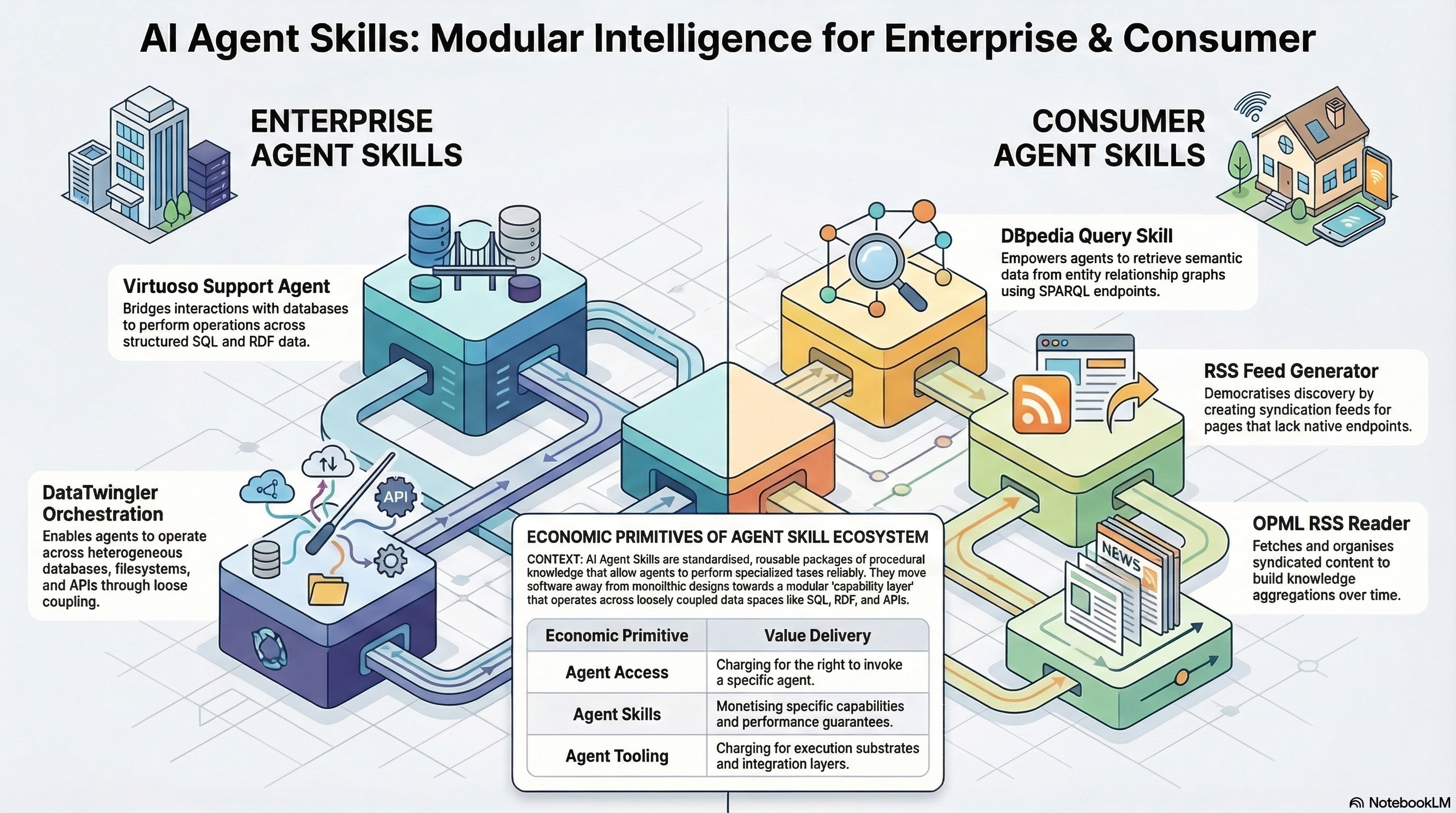
The AI revolution isn’t just about bigger models or faster inference — it’s about modularity, interoperability, and reusability. One of the most transformative concepts emerging in 2026 is the idea of AI Agent Skills — reusable units of procedural knowledge that empower AI agents to perform specialized tasks reliably and repeatably.
Agent Skills aren’t just a convenience; they are becoming economic primitives in the next generation of software ecosystems because they embody real, measurable units of value:
- Agent access — charging for the right to invoke an agent
- Agent skills — charging for specific capabilities
- Agent tooling — charging for execution substrates and integration layers
By breaking down monolithic capability into discrete, composable modules, Skills enable a new software value layer that’s more flexible, interoperable, and measurable than traditional applications.
What Are Agent Skills?
An Agent Skill is a structured package — usually a folder with a standard SKILL.md file — that defines when and how an AI agent should perform a specific task. This makes Skills:
- Reproducible
- Discoverable
- Reusable across AI agent frameworks
- Portable as simple instructions and optional scripts
Agent Skills follow an open standard (e.g., the agent-skills specification) that’s supported across Claude Code, Codex, Cursor, and other next-generation AI environments.
Skills can be installed locally or referenced directly from GitHub, making distribution and reuse democratized.
Examples from OpenLink Software’s AI Agent Skills Collection
The OpenLinkSoftware/ai-agent-skills repository on GitHub showcases a curated set of reusable Skills designed to operate in real data spaces and to harness semantic value across heterogeneous systems.
Here are a few standout examples:
Data Access at Internet & Web Scales
DBpedia & Wikidata Query Skills
Together, these Skills provide semantically informed access to two of the world’s most important public knowledge graphs, enabling entity discovery, enrichment, graph traversal, and federated data access across the broader Linked Open Data ecosystem.
DBpedia Query Skill
A Skill optimized for querying DBpedia SPARQL endpoints, inherently capable of federated querying across the massive Linked Open Data Cloud (the largest publicly accessible knowledge graph collective on the planet). This Skill focuses on semantically informed data retrieval and demonstrates how an agent can be empowered to interact with entity-relationship graphs, leveraging standardized identifiers and relationship-type semantics.
Wikidata Query Skill
A Skill optimized for querying Wikidata and related SPARQL-accessible knowledge graphs. It enables semantically informed retrieval over one of the world’s most comprehensive structured knowledge resources, making it ideal for entity discovery, enrichment, and graph-based reasoning.
Flexible Content Syndication
RSS and Atom Feed Generation Skill
This Skill generates RSS or Atom feeds for blogs, newsletters, and other pages that lack native syndication endpoints—enabling content discovery and distribution that aren’t constrained by a platform algorithm. This is useful for both public and private content syndication and publication.
Powerful Feed Reader
RSS, Atom, and OPML Feed Reader Skill
A Skill that reads OPML and RSS formats to fetch and organize syndicated content across data streams, enabling agents to build knowledge aggregations progressively over time. This enables persistence and reuse of knowledge automatically extracted from posts and articles for future use and enrichment of enterprise or personal knowledge.
Customer Support
Virtuoso Support Agent Skill
Your personal Virtuoso expert, capable of performing a variety of tasks that bring its immense data access, integration, and management (SQL tables and RDF knowledge graphs) capabilities to users, administrators, architects, data engineers, and developers—all through natural language invocation.
Together, this collection of Skills exemplifies modular intelligence: each Skill encodes purpose-specific logic that agents can invoke when contextual cues match.
Why Skills Matter for AI and Software
Agent Skills represent a shift in how software value is encapsulated and delivered.
Reusable Intelligence
Rather than rewriting the same instructions in every prompt, Skills centralize procedural knowledge into shareable modules.
Loose Coupling with Data Spaces
Skills aren’t tied to a monolithic backend; they can operate across databases, knowledge bases, filesystems, and APIs — a paradigm aligned with loosely coupled architectures.
Economic Units of Value
Developers and vendors can monetize at granular levels:
- Specific capabilities
- Performance guarantees
- Execution contexts
This transitions software economics from license seats and cloud usage to capability access and orchestration value.
How Skills Power Next-Generation AI Workflows
In practice, Skills allow AI agents to:
- Perform domain-specific automation (e.g., PDF extraction, API orchestration)
- Execute data queries over structured graphs
- Publish or aggregate syndicated content
- Bridge AI insights with real-world operational systems
Because Skills are standardized and discoverable, they can be composed — multiple Skills orchestrated together to solve complex tasks. This composability is part of why agent skill research emphasizes structured orchestration models (e.g., Skills as DAG workflows).
From Abstract AI to Practical Agents
As AI ecosystems continue maturing, Skills — especially when combined with loosely coupled data spaces — are rapidly becoming the foundation of agentic software infrastructure:
- Developers win by building reusable, shareable capabilities.
- Organizations win by lowering integration costs and raising predictability.
- Consumers win by gaining choice and transparency in automated workflows.
This is not theoretical — you can experiment today, load the Skills covered in this post into your preferred AI coding agent environment, and begin building production-ready agentic solutions.
Conclusion
The transition from monolithic software to loosely coupled composable AI agents is well underway. Skills are the practical units of this transformation — reusable, economic, interoperable building blocks that unlock powerful new capabilities while preserving existing tooling and standards.
By embracing Agent Skills — and designing them to transparently leverage structured data spaces — we’re finally seeing the long-promised convergence of semantic intelligence, modular software value, and real-world productivity.
Related
- OpenLink AI Agent Skills Repository on GitHub
- DBpedia Query Skill
- Wikidata Query Skill
- RSS and Atom Feed Generation Skill
- RSS, Atom, and OPML Feed Reader Skill
- Virtuoso Support Agent Skill
- NotebookLM generated slide deck about AI Agent Skills Economy
- Software Componentization in the Age of AI
- Trillion-Dollar++ Agentic Software Opportunity