The recent theCUBE Research analysis, “Alex Karp, Frontier Models, and the Real Fight for Enterprise AI,” captures an important shift in enterprise computing. It correctly argues that the next competitive battleground is not the foundation model itself, but the System of Intelligence that connects enterprise data, processes, and AI into a coherent whole.
I agree with that conclusion, but I diverge on the implied starting point.
The article frames the System of Intelligence as something enterprises now need to construct around large language models (LLMs). My perspective is that much of the necessary architecture already exists. What has changed is that LLMs have finally created demand for capabilities that the Web architecture, Linked Data, and Semantic Web communities (collectively, the Semantic Web Project) have been developing for more than twenty years.
In other words, AI has arrived at a destination that the Semantic Web Project identified long ago.
The Missing Question: What Is the System of Intelligence Built From?
The article repeatedly refers to concepts such as:
- System of Intelligence
- Enterprise ontology
- Digital twin
- Semantic operating layer
These are valuable abstractions, but they leave an important architectural question unanswered:
What is the representation model that allows independent systems to interoperate without becoming tightly coupled?
Without a common representation model, a System of Intelligence risks becoming yet another enterprise integration platform—a new monolith sitting above existing monoliths, generating compounding technical debt.
The challenge is not merely connecting systems. It is preserving their independence while enabling them to share meaning.
That has been the central design goal behind Linked Data and Data Spaces from the beginning.
Loose Coupling Is the Real Competitive Advantage
Enterprise computing has spent decades building increasingly sophisticated Systems of Record and associated operational know-how.
Applications then evolved into Systems of Engagement.
Today we are understandably focused on Systems of Intelligence (SOI).
The mistake would be treating this new layer as another centralized application.
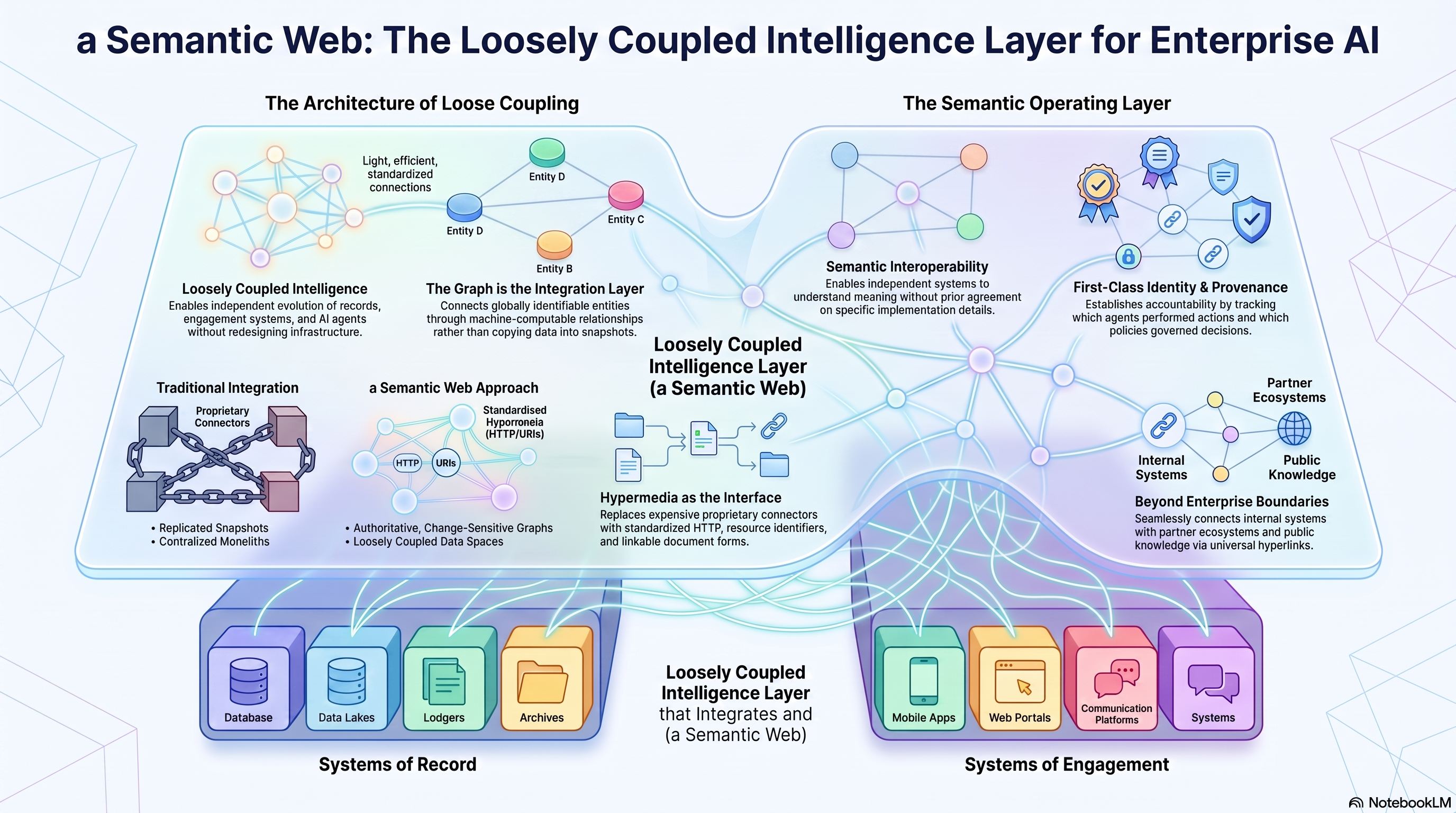
Instead, the intelligence layer should be a loosely coupled semantic layer, in Semantic Web form, that allows:
- Systems of Record to remain authoritative.
- Systems of Engagement to evolve independently.
- AI agents to consume change-sensitive enterprise knowledge rather than replicated snapshots.
- New AI agents, loosely coupled with skills, to emerge without redesigning existing systems.
This is precisely what a Semantic Web (public or private) comprising loosely coupled data spaces was intended to provide.
Rather than copying information into another platform, they expose existing information resources as globally identifiable entities connected through machine-computable relationships.
The entity relationship graph becomes the integration layer—not another database.
Knowledge Graphs Are More Than Enterprise Memory
Knowledge Graphs are often described as “enterprise memory.”
That description is incomplete.
Knowledge Graphs, when deployed as a Semantic Web in accordance with Linked Data principles, are better understood as the semantic operating layer of enterprise information.
They provide:
- semantic integration,
- abstraction over heterogeneous systems,
- contextual reasoning,
- entity identity,
- relationship preservation,
- machine-computable meaning, informed by an ontology
- and interoperability across organizational boundaries.
Their purpose is not merely to remember information.
Their purpose is to enable independent systems to understand one another without requiring prior agreement on implementation details—that is, interoperability.
That distinction becomes increasingly important as AI agents proliferate.
Hypermedia Is the Interface
Many discussions of enterprise AI focus heavily on connectors.
Connectors are useful.
They are also expensive.
Every proprietary connector introduces another maintenance burden.
The Architecture of the World Wide Web (AWWW) solved this problem decades ago, as demonstrated by the Web itself.
Instead of inventing a connector for every pair of applications, it standardized interaction around HTTP, resource identifiers, representations, and hyperlinks.
Enterprise AI should build upon the same principles.
Everything that matters should be:
- identifiable,
- addressable,
- linkable,
- dereferenceable,
- and describable in document form using shared semantics informed by ontologies (private or publicly shared).
That dramatically reduces coupling costs while increasing interoperability.
Identity Cannot Be an Afterthought
One area largely absent from current discussions of enterprise AI is identity.
As autonomous agents become active participants in enterprise workflows, questions become unavoidable:
- Which agent performed this action?
- On whose authority?
- Which policies governed the decision?
- Which data sources were consulted?
- What provenance supports the conclusion?
Without first-class identity, delegation, provenance, and policy enforcement, a System of Intelligence becomes difficult to trust.
Identity is not merely about authentication.
It is about establishing accountability throughout the reasoning process, where the following are also loosely coupled:
- identity
- identification (credentials)
- authentication (via various protocols)
- authorization (machine-computable, fine-grained attribute-based access control [ABAC])
- storage (data space read/write operations)
The Enterprise Is Not the Boundary
Many enterprise AI architectures assume the enterprise itself is the natural boundary.
It doesn’t have to be that way, due to what AWWW already provides.
Modern business depends upon suppliers, customers, regulators, industry partners, public datasets, research organizations, and increasingly, AI services operating across organizational boundaries.
A genuine System of Intelligence should seamlessly span:
- enterprise systems,
- partner ecosystems,
- public knowledge,
- private knowledge,
- and emerging agent ecosystems.
Knowledge Graphs built upon Linked Data principles naturally support this model because hyperlinks do not stop at organizational boundaries.
AI Doesn’t Replace the Web—It Finally Needs It
Large Language Models have dramatically increased demand for contextual information.
That does not mean we need an entirely new architectural foundation.
Quite the opposite.
The Web already provides many of the characteristics AI systems require:
- globally unique identifiers,
- resource discovery,
- hypermedia navigation,
- distributed ownership,
- standardized protocols,
- loosely coupled integration,
- graph-based knowledge representation,
- and machine-readable semantics.
Rather than inventing another enterprise platform, we should leverage these existing foundations.
The challenge is no longer convincing organizations that semantic interoperability matters.
The challenge is recognizing that enterprise AI depends upon it.
Looking Forward
The enterprise AI race is not fundamentally about who possesses the largest model.
Nor is it primarily about proprietary orchestration frameworks.
It is about constructing an intelligence layer capable of connecting diverse information assets without sacrificing independence, governance, or interoperability.
That problem predates generative AI by decades.
Today’s excitement around Systems of Intelligence is best viewed not as the beginning of a new architectural era, but as the convergence of AI with longstanding principles from AWWW and the Semantic Web Project.
The frontier is not simply enterprise AI.
The frontier is a Web of interoperable intelligence.