The Agent Engineering Stack Nobody Shows You
Most AI agent diagrams are beautiful.
Few survive contact with a real deployed system.
This one did.
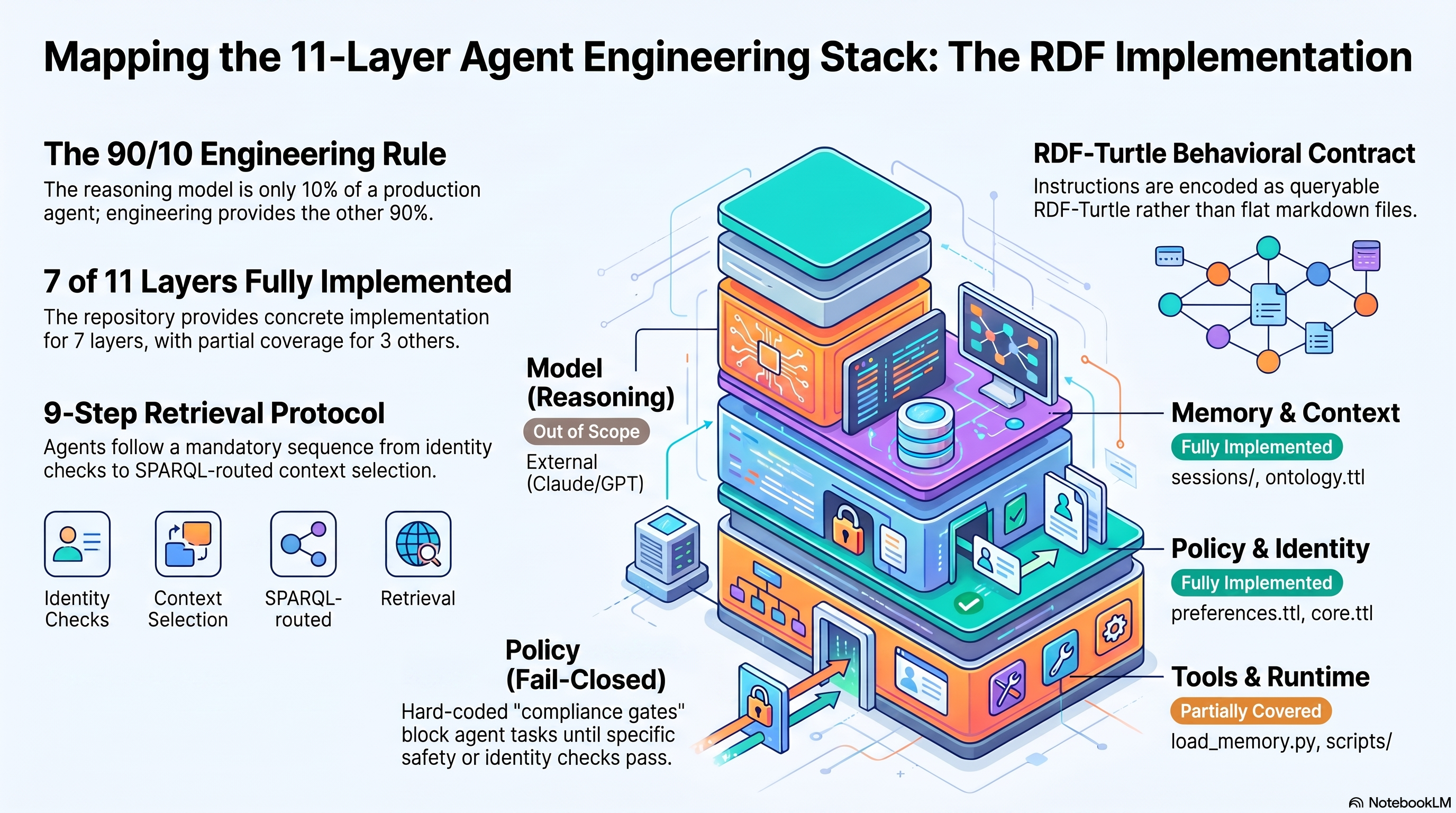
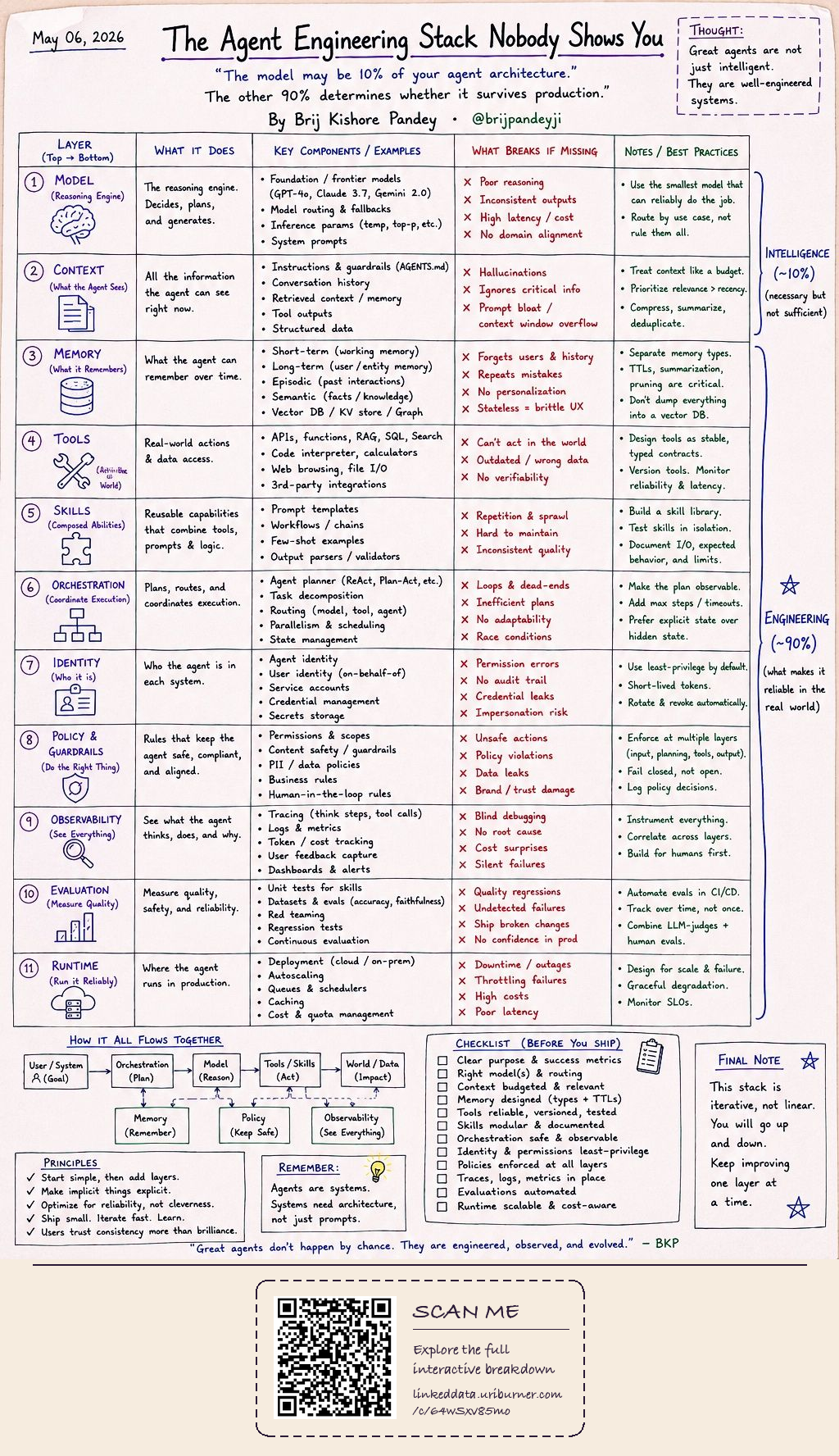
A hand-drawn infographic described an 11-layer Agent Engineering Stack: Model, Context, Memory, Tools, Skills, Orchestration, Identity, Policy & Guardrails, Observability, Evaluation, and Runtime.
Useful? Yes.
But a diagram is only a promise until someone asks the hard question:
Where is this implemented?
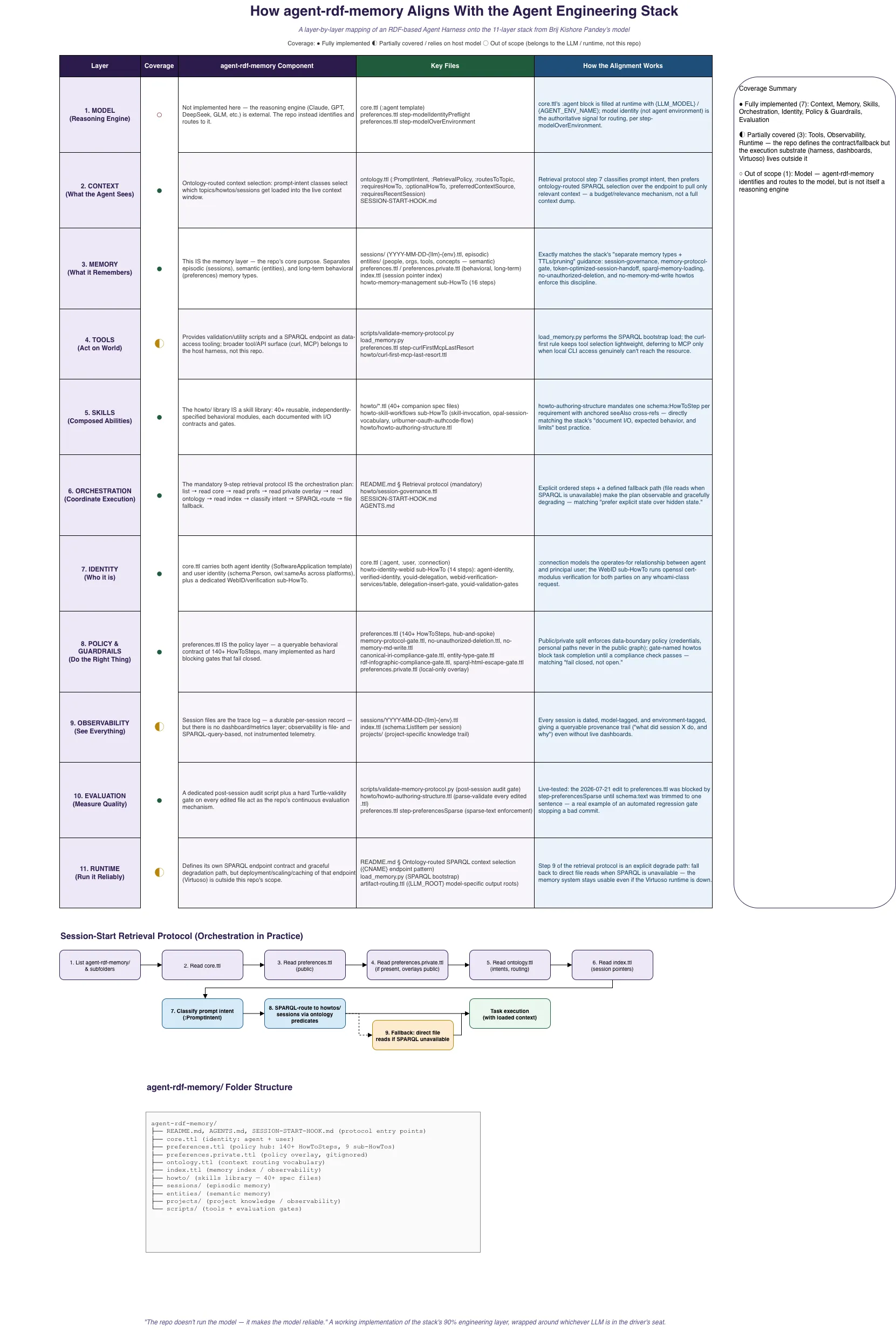
So we took the stack and mapped it against a working system: agent-rdf-memory, a portable RDF-Turtle memory and behavioral contract for AI coding agents.
Not a slide.
Not a slogan.
A real set of files an agent can read, follow, query, and be judged against.
A Diagram Became an Audit
The exercise started simply enough.
An LLM redrew a hand-made infographic into a working draw.io file. Then the real work began. Every claim in the diagram had to be defended against code, documents, folders, scripts, and public repository links.
That is where most agent architecture talk gets uncomfortable.
It is easy to say an agent has “memory.”
It is harder to point to episodic session files, semantic entity records, and long-term behavioral preferences.
It is easy to say an agent has “guardrails.”
It is harder to show a queryable policy file with hard gates, task rules, and procedure-specific instructions.
It is easy to say an agent is “observable.”
It is harder to show durable traces that explain what happened, when, why, and under whose authority.
The value of agent-rdf-memory is that it turns these words into inspectable Linked Data.
The Finding
The 11-layer stack maps surprisingly well.
Seven layers are fully implemented:
Context. Memory. Skills. Orchestration. Identity. Policy & Guardrails. Evaluation.
Three are partially covered:
Tools. Observability. Runtime.
One is deliberately out of scope:
Model.
That last point matters. The model itself, whether Claude, GPT, DeepSeek, GLM, or another reasoning engine, is external. The repository does not pretend otherwise. It identifies the active agent and routes behavior through core.ttl, but the reasoning engine remains outside the memory system.
That is good architecture. It separates the mind from the operating contract.
What the Agent Sees
The Context layer is fully implemented.
An agent does not merely receive a blob of prompt text and hope for the best. It is guided by ontology-routed context selection through ontology.ttl.
That means prompts, task types, and operational rules can be classified. The agent can discover which guidance applies instead of relying on a brittle wall of instructions.
This is the difference between context as a pile and context as a map.
What the Agent Remembers
Memory is the heart of the system.
The repository provides episodic memory through sessions/, semantic memory through entities/, and long-term behavioral memory through preferences.ttl.
This is not “memory” as a chat transcript.
It is memory as Linked Data: named things, relationships, provenance, rules, session lessons, and reusable instructions.
An agent can be reminded not only of what happened, but of what that event means for future work.
What the Agent Can Do
The Tools layer is partially covered.
The repository includes validation scripts and load_memory.py, which help agents load and inspect the memory graph.
But the broader tool surface belongs to the host harness: browser control, file editing, shell execution, WebDAV, SPARQL endpoints, and other external capabilities.
This is the right boundary. agent-rdf-memory does not need to be the hands. It needs to tell the hands what matters.
What the Agent Knows How to Do
Skills are fully implemented.
The howto/ folder acts as a library of executable operating knowledge.
These are not generic tips. They are task-shaped instructions: identity, WebID, memory protocol, artifact routing, RDF authoring, KG Explorer rules, SPARQL behavior, terminology, destructive command guards, and more.
A good skill system should reduce improvisation where precision matters. This one does.
Who the Agent Is Acting For
Identity is fully implemented.
The system defines the agent, the user, and the relationship between them. It supports WebID-oriented behavior and identity-specific operating rules through core.ttl and the agent identity HowTo.
That matters because serious agent work is delegated work.
The question is not merely “Can the agent do this?”
It is “Who is the agent acting for, under what authority, and according to which rules?”
Without identity, an agent is just a tool call in motion.
With identity, it can become an accountable participant in a governed workflow.
The Policy Layer Is the Product
The most important layer may be Policy & Guardrails.
In many systems, guardrails are treated as warnings. Here they are operational memory.
preferences.ttl is a behavioral contract: structured, queryable, and connected to specific HowTo files. It tells the agent how to work, where to place artifacts, when to verify, when to avoid fabrication, how to preserve terminology, and how to handle high-risk operations.
This is more than safety. It is quality control.
It gives the agent a house style, a memory of prior failures, and a way to improve without relying on vibes.
Why Inline Links Matter
An earlier version of the diagram used a separate “GitHub” column full of clickable chips.
It looked useful.
But it added chrome where the prose already had meaning.
The better choice was to hyperlink the first mention of each real file or folder inline, in row-reading order. That way the reader meets the evidence exactly where the claim is made.
No decorative reference column.
No link theater.
Just a claim, then its proof.
Two items were deliberately left unlinked: preferences.private.ttl and projects/. Both are gitignored and absent from the public repository tree. Linking them would have produced 404s.
That small decision says a lot about the discipline behind the work: never fabricate a public URL just because the diagram wants one.
How It Was Verified
The method was simple and strict.
Read the repository’s own documentation first. Map every stack layer to concrete implementation files. Classify each layer as fully implemented, partially covered, or out of scope. Verify candidate links against the live GitHub repository tree. Then generate RDF and HTML artifacts from the resulting document.
All 25 distinct GitHub URLs referenced across the RDF, HTML, and companion document were checked against the GitHub Git Trees API on July 21, 2026.
None were guessed.
That is the standard agent systems need: not confidence, but evidence.
The Real Benefit
The practical benefit is not merely a better diagram.
The benefit is a richer operating environment for AI agents.
An agent with RDF memory can carry context forward. It can follow standing instructions. It can distinguish public facts from private rules. It can preserve identity, provenance, and task history. It can explain why it acted as it did. It can be evaluated against contracts instead of impressions.
This is how agent engineering moves from clever demos to durable systems.
Not by making agents sound more human.
By giving them memory, identity, policy, skills, and evidence they can actually use.
The Point
The Agent Engineering Stack is a useful abstraction.
agent-rdf-memory shows what that abstraction looks like when it is made concrete.
It does not implement the model. It does not replace the host runtime. It does not pretend the tool layer lives entirely inside the repository.
But it implements the parts that make an agent governable:
What it sees.
What it remembers.
What it knows how to do.
Who it acts for.
Which rules it must obey.
How its work is checked.
That is the stack most people do not show you.
And it may be the part that matters most.
Video Presentation
Related Live Showcases
- Example of a Blog Post created using an AI Agent constrained by the RDF-Agent Memory System
- Example of a Company Weblog (Blog) created by the same AI Agent
- Example of a Shared Notes Weblog (Blog) created by the same AI Agent
- Example of a World Cup 2026 Tournamet Weblog (Blog) created by the same AI Agent