Linked Open Agentic Commerce (LOAC)
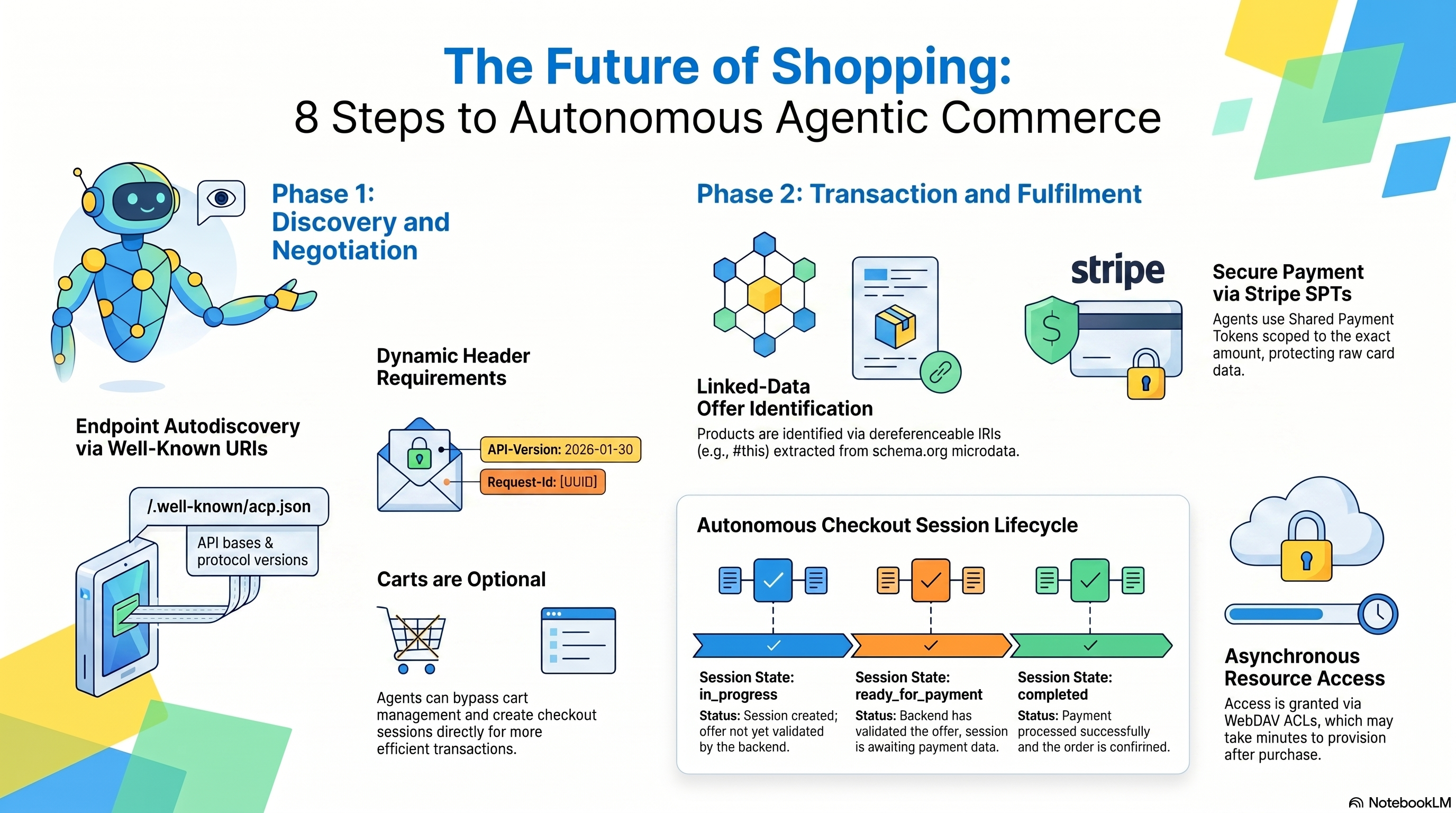
AI-era commerce needs a representation layer that is simultaneously human-readable and machine-computable — where principals, agents, offers, licenses, and authority are all first-class, verifiable entities.
The Problem with AI-Era Commerce
Commerce systems were designed for humans clicking through interfaces, not for software agents acting autonomously on behalf of humans.
Product catalogs, pricing, and licensing terms remain trapped in HTML pages optimized for visual consumption. For an AI agent, these are effectively unstructured documents. For a human principal, they are not directly verifiable in machine-executable form.
At the same time, commerce is already becoming agent-mediated. People increasingly delegate discovery, negotiation, and purchase decisions to AI systems.
But here is the gap:
We have agentic execution without agentic representation.
An agent cannot reason over what it cannot parse.
A human cannot audit what is not formally represented.
A merchant cannot safely transact with an agent whose authority cannot be verified.
The result is a structural mismatch between economic action and computable meaning.
The Missing Layer: Delegated Identity
Before we talk about products, we must talk about who is acting.
Every commerce transaction involves at least two distinct roles:
- A Principal — a human or organization that owns rights, obligations, and outcomes
- An Agent — a software system executing actions on behalf of a principal
Yet in today’s systems, this relationship is implicit, buried inside sessions, cookies, API keys, or UI logins.
That is no longer sufficient.
In an agentic economy, we must explicitly represent:
- who the agent is
- who it represents
- what authority has been delegated
- what scope that authority covers
- and how to audit everything that happens under that delegation
For example:
| Role | Identity |
|---|---|
| Principal | Kingsley Uyi Idehen |
| Principal Identifier | https://www.linkedin.com/in/kidehen#this |
| Agent | Claude Sonnet 4.6 |
| Execution Environment | Claude Code |
| Relationship | Acts on behalf of Principal |
A transaction is therefore not:
“Claude purchased a license.”
It is:
“Claude Sonnet 4.6, acting on behalf of Kingsley Uyi Idehen, purchased a license.”
That distinction determines ownership, liability, access rights, auditability, and revocation semantics.
Introducing Linked Open Agentic Commerce (LOAC)
LOAC is a model for representing commerce as a linked data-based entity-relationship graph constructed using hyperlinks as the primary mechanism of identity and traversal.
In LOAC:
Commerce is a navigable entity-relationship graph of principals, agents, offers, licenses, and access rights.
Each element is a first-class entity:
- principals
- agents
- offers
- licenses
- resources
- and the relationships between them
Each entity is identified using a dereferenceable IRI and described using shared vocabularies such as schema.org and related ontologies.
For example:
- An Offer:
http://data.openlinksw.com/oplweb/offer/TestFileAccessOfferOds-qa#this - A License:
http://data.openlinksw.com/oplweb/license/TestFileAccessLicenseOds-qa#this - A Protected Resource:
https://ods-qa.openlinksw.com/DAV/data/TestFile.txt
These are not opaque identifiers behind a proprietary API.
They are nodes in a hyperlink-based entity-relationship graph.
How LOAC Works (in Practice)
LOAC operates by making every layer of commerce both discoverable and computable.
1. Discovery via Linked Endpoints
An agent begins with a well-known entry point:
GET https://ods-qa.openlinksw.com/.well-known/acp.json
This exposes:
- protocol capabilities
- API entry points
- supported workflows
- machine-readable contracts
Nothing is hard-coded. Everything is discoverable.
2. Commerce as an Entity-Relationship Graph
LOAC represents commerce as a hyperlink-constructed entity-relationship graph, where:
- nodes are entities (principals, agents, offers, licenses, resources)
- edges are typed relationships (delegates, grants, governs, accesses)
- hyperlinks serve as both identifiers and traversal mechanisms
The agent traverses:
Principal → Agent → Offer → License → Resource
Each step is a dereferenceable relationship in the graph.
Humans see documents.
Agents traverse meaning.
3. Enforcement via Attribute-Based Access Control
When a purchase occurs, the system does not toggle a flag.
It generates an ABAC policy expressed as RDF, binding:
- principal identity
- license terms
- resource access constraints
Before purchase:
curl --digest -u demo:demo -I -L \
"https://ods-qa.openlinksw.com/DAV/data/TestFile.txt"
Response progression:
401 Unauthorized402 Payment Required
After purchase and provisioning:
200 OK
Access is derived from the entity-relationship graph, not embedded state.
4. Orchestration vs Settlement
LOAC separates responsibilities:
- Agentic Commerce Protocol (ACP) → discovery, negotiation, ordering
- Merchant Payment Protocol (MPP) → payment, invoicing, settlement
This separation ensures:
- payment providers can change independently
- product structure remains stable
- access control remains consistent
Proof: A Complete Agentic Purchase Flow
A full end-to-end transaction on the ods-qa platform demonstrates LOAC in action.
Entities
| Entity | IRI | Role |
|---|---|---|
| Principal | https://www.linkedin.com/in/kidehen#this | Beneficiary |
| Offer | http://data.openlinksw.com/oplweb/offer/TestFileAccessOfferOds-qa#this | Product |
| License | http://data.openlinksw.com/oplweb/license/TestFileAccessLicenseOds-qa#this | Rights |
| Resource | https://ods-qa.openlinksw.com/DAV/data/TestFile.txt | Asset |
Flow
Principal → Agent → Offer → License → Resource
Each transition is a traversal of the hyperlink-based entity-relationship graph.
Everything remains linked, discoverable, and auditable.
Subscription Settlement Example
For subscription-based offers, ACP returns a payment link to a hosted invoice:
Pay OPENLINK SOFTWARE INC.
Invoice #GWKSR46N-0001
$9.99
After payment:
✓ Invoice paid
Payment method: Visa •••• 4242
ACP orchestrates.
MPP settles.
Asynchronous Provisioning
Access is provisioned asynchronously.
During this window:
403 Forbidden
Agents poll until access becomes available:
while true; do
  STATUS=$(curl -s -o /dev/null -w "%{http_code}" \
    -H "Authorization: Bearer $TOKEN" \
    "$RESOURCE")

  [ "$STATUS" = "200" ] && break
  sleep 5
done
Eventually:
200 OK
Why This Changes Everything
LOAC introduces three structural shifts:
1. Commerce becomes a hyperlink-based entity-relationship graph
Products are no longer records. They are nodes in a computable relational structure.
2. Identity becomes explicit
Principal–agent relationships are first-class entities in the graph.
3. Payment becomes decoupled
Settlement is no longer embedded in commerce logic.
The Bigger Picture
LOAC applies Linked Data principles directly to commerce systems.
- Discovery is a dereferenced URI
- Principals are identifiable entities
- Agents act on behalf of principals through explicit relationships
- Products are entities in an entity-relationship graph
- Offers are typed relationships containing terms
- Licenses are policy entities governing access
- Purchases are protocol interactions over graph traversal paths
- Payments are externalized settlement flows
- Access is governed by RDF-based ABAC policies
- Provenance is preserved across the entire lifecycle
An agent does not need proprietary integrations.
It needs HTTP, RDF, and a shared model of an entity-relationship graph constructed using hyperlinks.
The result is commerce that is:
- readable by humans
- executable by agents
- verifiable by both
The catalog is a graph.
The license is a graph.
The identity is a graph.
But more precisely:
They are all entities in a hyperlink-based entity-relationship graph.
And the hyperlink is the API.
Detailed Workflow Breakdown (Activity Tracing Details)
This simplified workflow covers the purchase of rights to access a basic text file. The example is intentionally simple to make it easier to understand how commercial workflows scale to digital artifacts of all kinds. At their core, these artifacts are ultimately files—whether data snippets, datasets, blog posts, articles, books, music, or other forms of digital content—whose access is governed by ABAC-enforced policies derived from the associated license.
1. Execution Context
This trace is executed under an explicit delegation relationship:
- Principal: Kingsley Uyi Idehen
WebID: https://www.linkedin.com/in/kidehen#this - Agent: Claude Sonnet 4.6
Execution Environment: Claude Code (CLI/Desktop) - Delegation Model: On-behalf-of execution under ACP authorization
- Target System: ods-qa staging environment
Base: https://ods-qa.openlinksw.com - Protocols:
- Agentic Commerce Protocol (ACP)
- Merchant Payment Protocol (MPP)
- Stripe test-mode settlement layer
2. Event: Discovery of Commerce Entry Point
curl -s "https://ods-qa.openlinksw.com/.well-known/acp.json"
Interpretation
This is the initial dereference into the commerce entity-relationship graph.
- No prior API knowledge required
- System advertises its own capabilities
- Entry point is a well-known URI (RFC 8615)
3. Event: Retrieval of Machine-Readable Contract
curl -s -H "Authorization: Bearer <TOKEN>" \
  "https://ods-qa.openlinksw.com/acp/openapi.json"
Interpretation
This step resolves the operational contract of the ACP subsystem:
- Available entities: carts, checkout_sessions, orders
- Allowed operations
- Authentication requirements
- Protocol surface
At this stage, the agent has discovered the action space of the commerce system.
4. Event: Checkout Session Creation (Offer Traversal → Order Initiation)
export ACP_AUTH_TOKEN="<TOKEN>"
export ACP_ITEM_ID="http://data.openlinksw.com/oplweb/offer/TestFileAccessOfferOds-qa#this"
export ACP_BASE_URL="https://ods-qa.openlinksw.com/acp"

curl -s -X POST \
  -H "Authorization: Bearer ${ACP_AUTH_TOKEN}" \
  -H "API-Version: 1.0" \
  -H "Idempotency-Key: $(uuidgen)" \
  -H "Content-Type: application/json" \
  "${ACP_BASE_URL}/checkout_sessions" \
  -d '{
    "currency": "usd",
    "capabilities": ["payment"],
    "line_items": [{
      "item": {
        "id": "'"${ACP_ITEM_ID}"'"
      },
      "quantity": 1
    }]
  }'
Interpretation
This is the first economic act over the entity-relationship graph:
- Offer IRI is dereferenced as a graph node
- Checkout session is created as a transient transactional entity
- Idempotency ensures safe replay semantics
At this point: A potential purchase has been instantiated but not yet settled.
5. Event: Payment Instrument Provisioning (Stripe SPT Creation)
5.1 Payment Method Creation
curl -s -X POST "https://api.stripe.com/v1/payment_methods" \
  -u "<STRIPE_SECRET_KEY>:" \
  -H "Content-Type: application/x-www-form-urlencoded" \
  -d "type=card&card[number]=4242424242424242&card[exp_month]=12&card[exp_year]=2028&card[cvc]=123"
Interpretation
This creates a payment instrument binding in the settlement layer (MPP boundary begins here).
5.2 Shared Payment Token (SPT)
SPT_EXPIRES=$(($(date +%s) + 3600))

curl -s -X POST \
  "https://api.stripe.com/v1/test_helpers/shared_payment/granted_tokens" \
  -u "<STRIPE_SECRET_KEY>:" \
  -d "payment_method=<PAYMENT_METHOD_ID>" \
  -d "usage_limits[currency]=usd" \
  -d "usage_limits[max_amount]=<AMOUNT_IN_CENTS>" \
  -d "usage_limits[expires_at]=${SPT_EXPIRES}"
Interpretation
This is the delegated payment authorization artifact:
- Scoped monetary authority
- Time-bounded usage rights
- Cryptographically bound to a payment method
This token becomes the settlement credential passed into ACP.
6. Event: Order Completion (ACP → MPP Boundary Crossing)
curl -sS -X POST \
  "${ACP_BASE_URL}/checkout_sessions/<CHECKOUT_SESSION_ID>/complete" \
  -H "Authorization: Bearer ${ACP_AUTH_TOKEN}" \
  -H "API-Version: 2026-01-30" \
  -H "Idempotency-Key: $(uuidgen)" \
  -H "Content-Type: application/json" \
  -d '{
    "payment_data": {
      "handler_id": "card_tokenized",
      "instrument": {
        "type": "spt",
        "credential": {
          "type": "spt",
          "token": "'"${SPT_TOKEN}"'"
        }
      }
    }
  }'
Interpretation
This is the formal transition from orchestration (ACP) to settlement (MPP).
At this moment:
- Order becomes binding
- Payment authorization is consumed
- Resource access is conditionally authorized
- ACL provisioning pipeline is triggered
7. Event: Subscription Payment Resolution (Conditional Branch)
If present: rel="subscription_payment"
The system enters an external settlement path.
Interpretation
This represents a deferred settlement state in the entity-relationship graph where:
- ACP has completed orchestration
- MPP delegates final settlement to hosted invoice flow
- External payment UI resolves financial completion
8. Event: Resource Access Validation (ACL Enforcement Loop)
RESOURCE_URL="https://ods-qa.openlinksw.com/DAV/data/TestFile.txt"

for i in $(seq 1 10); do
  STATUS=$(curl -sS -o /dev/null -w "%{http_code}" \
    -H "Authorization: Bearer ${ACP_AUTH_TOKEN}" \
    "${RESOURCE_URL}")
  if [ "$STATUS" = "200" ]; then
    echo "ACCESS GRANTED"
    break
  fi
  sleep 5
done
Interpretation
This is the policy enforcement realization phase:
- ACL is being materialized from RDF policy
- Access rights propagate asynchronously
- System transitions from denied → authorized state
State machine: NOT PROVISIONED → 403 → PROVISIONED → 200
9. Event: Final State — Resource Dereference Success
200 OK
Interpretation
This marks completion of the economic + semantic transaction cycle:
- Offer selected
- License instantiated
- Payment settled
- ACL provisioned
- Resource dereferenced successfully
10. System-Level Interpretation
This entire trace represents a traversal of a hyperlink-based entity-relationship graph where economic actions are state transitions over linked entities, governed by ACP (orchestration) and MPP (settlement), under delegated principal–agent identity.
11. Final State Assertion
- Commerce event: COMPLETED
- Identity chain: VERIFIED (Principal → Agent)
- Settlement: CONFIRMED
- Access control: PROVISIONED
- Resource state: ACCESSIBLE