VOICE: Governed Context for Enterprise AI
Enterprise AI doesn’t need another data silo. It needs governed access to existing knowledge, persistent memory, and the ability to act.
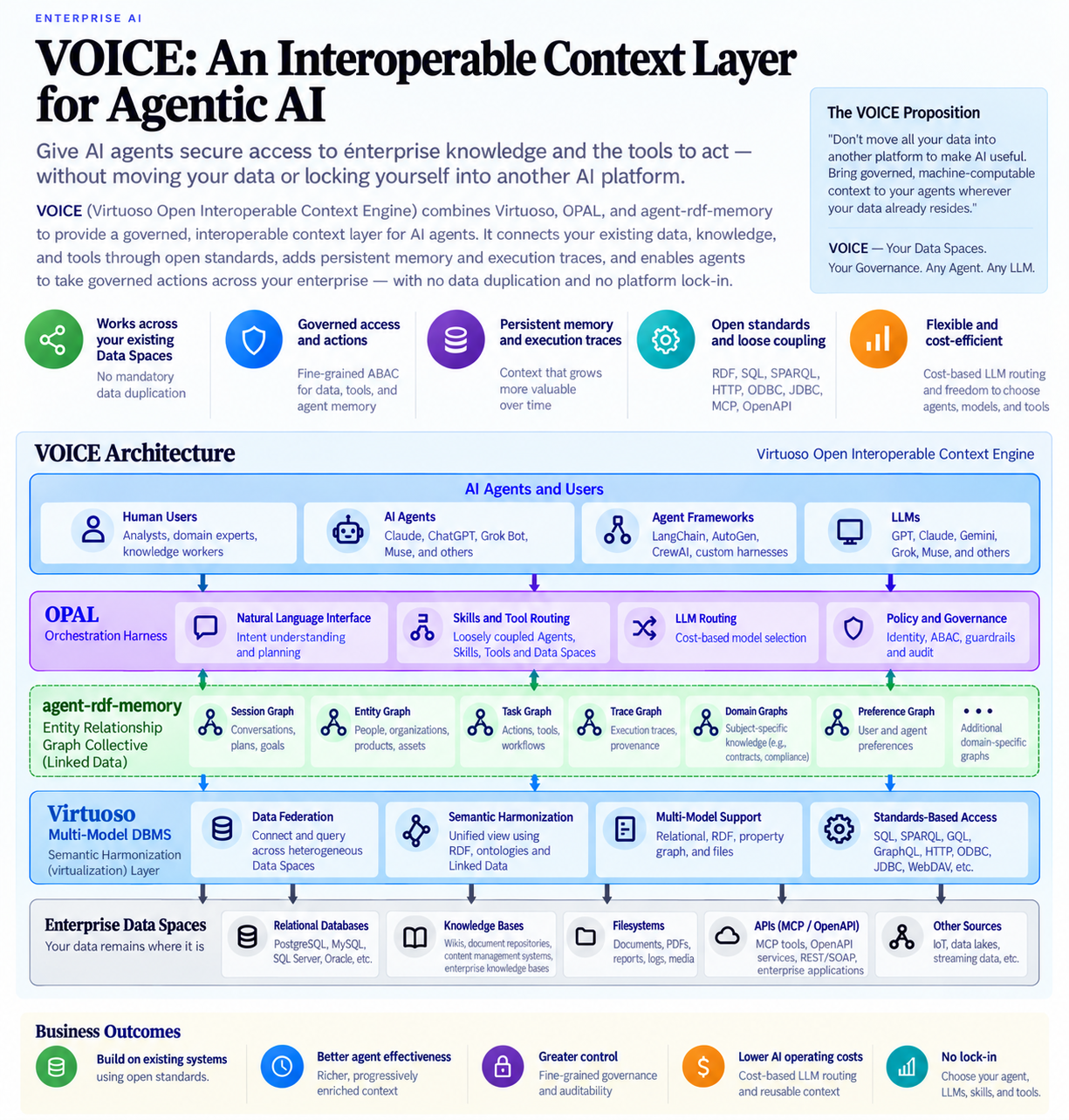
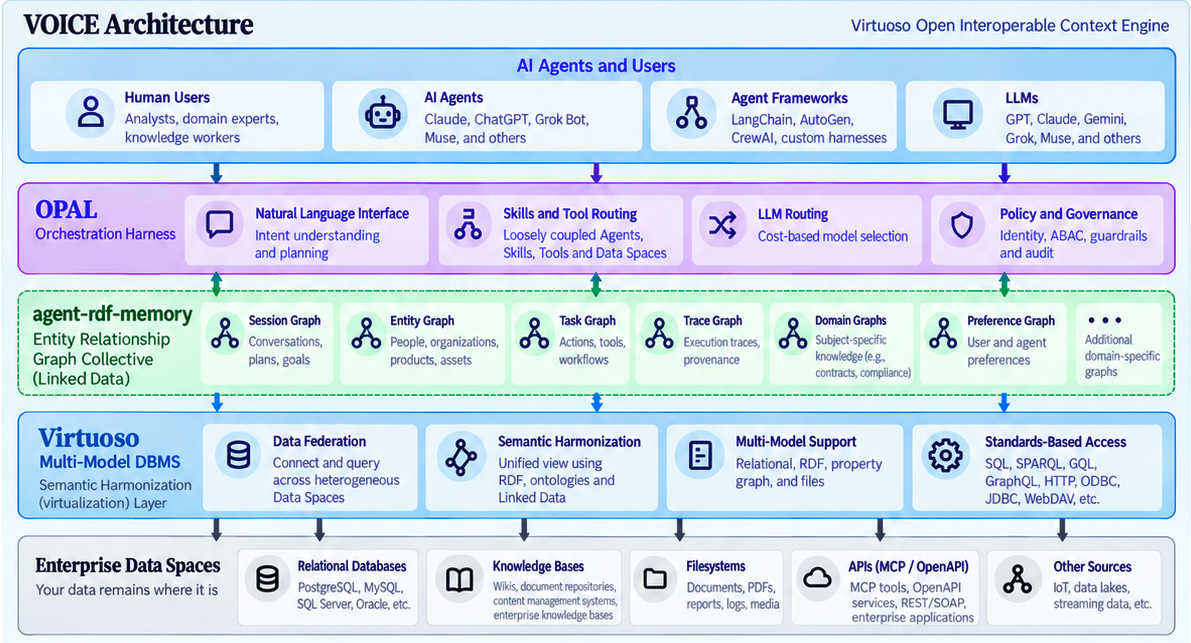
VOICE combines Virtuoso, OPAL, and agent-rdf-memory into a loosely coupled infrastructure for AI agents.
Its distinguishing proposition is straightforward:
VOICE doesn’t require enterprise data, AI agents, or LLMs to converge on a single proprietary platform. It connects them through open standards, shared semantics, and fine-grained governance.
What makes VOICE different?
Many AI-ready data strategies bring data, analytics, knowledge graphs, and AI capabilities closer together within their respective ecosystems.
VOICE starts from a different premise:
Your enterprise already has Data Spaces—databases, knowledge bases, filesystems, and APIs—containing valuable data, information, and know-how accumulated over years of operation.
Yet access to data alone does not give an AI agent the context to understand what that data means. Relevant information is spread across systems, business concepts and relationships may be unclear, and agents need to operate within the organization’s governance rules.
The core challenge is to give agents reliable access to existing enterprise knowledge, enough context to interpret it, and governed ways to act on it.
VOICE brings together three complementary capabilities:
-
Virtuoso — Federated Data Access and Semantic Context: A multi-model DBMS combining relational tables, RDF knowledge graphs, and semantic data harmonization. It provides a machine-computable semantic layer across heterogeneous Data Spaces without requiring wholesale data duplication.
-
OPAL — Intent-to-Action Orchestration: An AI harness that connects natural-language intent to executable queries and actions through the loose coupling of Agents, Skills, Tools, and Data Spaces. It supports cost-based LLM routing, so model selection can reflect task requirements and economics rather than dependence on a single provider.
-
agent-rdf-memory — Persistent Memory and Progressive Knowledge Enrichment: An open-standards-based memory layer, enabled by RDF, comprising a collection of entity-relationship graphs built with standardized, platform-independent identifiers. It preserves relevant session histories, execution traces, decisions, and provenance as reusable, machine-computable context, supporting progressive knowledge-graph enrichment across sessions and workflows.
The architectural distinction
VOICE combines capabilities that are often treated as separate products or platform-specific features.
| Capability | VOICE approach | Enterprise benefit |
|---|---|---|
| Data access | Federated, standards-based access across existing Data Spaces | Less migration and duplication |
| Semantic context | RDF, Linked Data, ontologies, and semantic data harmonization | Consistent entity identification and relationship discovery |
| Agent orchestration | Loosely coupled Agents, Skills, Tools, and Data Spaces | Freedom to change agent frameworks and tools |
| LLM selection | Cost-based routing across supported models | Greater flexibility and cost control |
| Identity and governance | Verifiable identity and fine-grained ABAC | Governed access for humans and agents |
| Persistent memory | RDF-based session history, relationships, and provenance | Reusable knowledge across interactions |
| Execution traces | Machine-computable records of relevant agent activities and outcomes | Auditability, debugging, and reproducibility |
| Progressive enrichment | New findings and relationships incorporated into persistent context | Knowledge that accumulates rather than disappearing between sessions |
VOICE is an architectural deliverable: its distinction lies in how these capabilities work together without requiring tight coupling to one database, one agent framework, one LLM, or one proprietary ecosystem.
A concrete example: Enterprise contract intelligence
Consider an AI agent asked:
“Which customer contracts are affected by a supplier’s new compliance requirements, and what actions should we take?”
With VOICE, the workflow can:
- Discover: Identify relevant contracts, suppliers, customers, and compliance requirements across databases, document repositories, and APIs.
- Connect: Use shared identifiers, RDF relationships, and ontologies to correlate information across those sources.
- Recall: Retrieve relevant findings, decisions, and execution traces from previous agent sessions.
- Reason: Use an appropriate LLM alongside machine-computable context to evaluate potential impacts.
- Act: Invoke authorized tools to prepare reports, create tasks, or initiate approval workflows, subject to access controls.
- Enrich: Preserve useful findings, new relationships, provenance, and execution outcomes for future interactions.
The next agent session doesn’t have to rediscover everything from scratch.
Knowledge accumulates. Context improves. Actions remain governed.
How VOICE in relation to context engine oriented offerings from Databricks, Snowflake, and Neo4j
Databricks Genie One, Snowflake Cortex Analyst and Horizon Context, and Neo4j Context Engine each offer capabilities for connecting AI to business data and context.
VOICE’s differentiation is not a claim that those platforms lack semantic, governance, or AI functionality. It is an architectural choice delivered as a working combination of components.
Rather than making a particular platform the center of enterprise AI, VOICE emphasizes:
- Data Space independence: Existing systems remain authoritative sources.
- Agent independence: Different agents and harnesses can use the same governed context.
- LLM independence: Models can be selected or replaced according to task requirements and cost.
- Standards-based interoperability: RDF, Linked Data, SQL, SPARQL, HTTP, ODBC, JDBC, MCP, and OpenAPI provide reusable integration interfaces.
- Persistent, portable context: Machine-computable memory, provenance, and execution traces are not inherently tied to one LLM’s conversation history.
- Governance across boundaries: Identity, authentication, authorization, and storage remain distinct architectural concerns.
This positions VOICE as a complement to existing enterprise platforms as well as an alternative to tightly integrated AI context stacks.
The business value
VOICE is designed to help enterprises:
Reduce integration costs by reusing existing systems and open standards.
Reduce AI operating costs through selective LLM routing and reusable context.
Reduce repeated work by preserving relevant session histories, execution traces, and accumulated knowledge.
Improve agent effectiveness by combining current enterprise information with progressively enriched semantic context.
Strengthen governance through fine-grained control over data access, memory retrieval, and action execution.
Protect existing investments by avoiding unnecessary migrations and platform dependencies.
Live SQL, SPASQL, and SPARQL examples
These selected Databricks- and Neo4j-referencing posts link directly to live showcase query sections using data on demo.openlinksw.com.
Databricks-referenced showcase: The portfolio example uses invented data and demonstrates:
Neo4j-referenced showcase: The ScaleKG example demonstrates:
The VOICE proposition
Most AI platforms help agents work with data. VOICE is designed to help agents work across Data Spaces, remember what they’ve learned, and execute governed actions using that knowledge.
That’s the difference between merely supplying context to an LLM and building a persistent, interoperable context infrastructure for enterprise AI.
VOICE — Your Data. Your Know-how. Any Agent. Any LLM.
From intent to governed action, with context that grows more valuable over time.
Infographic